

Q&A With Patricia Bellan-Gillen
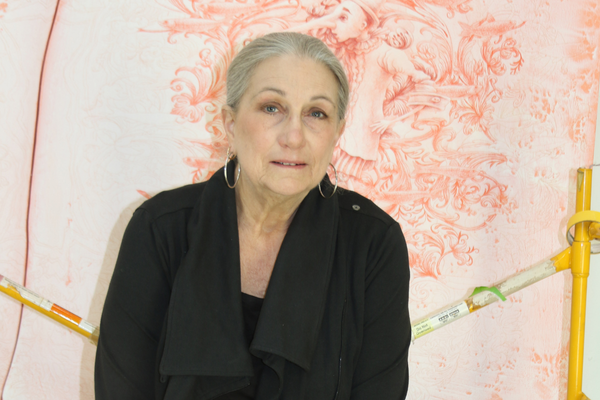
Patricia Bellan-Gillen chats about nearly 30 years of teaching art, the moral lessons hiding in classic children's stories, and how Moby Dick and Jonah and the Whale shaped her exhibition's title.
Tell us a little bit about yourself and your background.
I was a very lucky kid. I could draw realistically well at a very young age and people noticed. My mother, a clerk at G. C. Murphy’s and my father, employed at the local tube mill, made sure that my sister and I always had art supplies and space on the dining room table to draw and paint. “The John Gnagy Learn to Draw” program was on television and my sister took us through every step-by-step drawing and exercise in his book. Seventy years later, we both claim we could draw the Doberman and the “train tracks in perspective” from memory.
The wonder of the art world opened for me at age ten when Mary Lato Lestyan, a classically trained artist from Hungary moved to my hometown and welcomed me into her adult oil painting class. In addition to teaching classic oil painting techniques, she began every evening with an art history lecture. I was thrilled to learn that this “activity” that I loved had a long and important history.
From early on, I knew that I wanted to teach art. I began my art educator career at age 16, painting and crafting with neighborhood kids on my parent’s living room floor and retired after 29 years from my dream job as an endowed professor in the School of Art at Carnegie Mellon University.
What collegiate and artistic experiences have influenced your practice?
Without resorting to hyperbole or cliché, it is hard to describe the profound impact my years of study at Edinboro State College had on my life and artistic development. I’ll just say those years were magical and my ideas about art and making art were challenged, confirmed, expanded and deepened. During my first two semesters at Edinboro, I saw exhibitions featuring the intricate drawings of underground comic book artist, Robert Crumb, documentation of the performance work of Vito Acconci, the ceramic work of Wayne Higby and the paintings of British painter, John Walker. It was gratifying to see this variety of work all valued, all deemed of importance in the halls of a state art school in 1971.
Being surrounded by a talented core group of students who loved the process of creating art was the most important facet of my college experience. These were people who preferred to spend their evenings and most weekends in Loveland and East Halls making art. Most of us were working-class kids and the first in our families to attend college. Very few of us envisioned ourselves making our living as artists, but I think we all intuitively knew that art could play a vital part of how we lived our lives.
One of the most significant and impactful art experiences in my life also occurred during my BFA studies. “Art doesn’t mean, Art is,” was a statement or cliché often repeated during the mid 1970’s. I heard a visiting artist repeat the statement and with great emphasis added that painting cannot portray emotion. Within a few days of hearing that pronouncement, the Art Department sponsored a field trip to New York City. We arrived in Manhattan in the morning and went straight to the Museum of Modern Art. MOMA still housed Picasso’s Guernica, his huge, brutal and powerful painting created in reaction to the devastating Nazi bombing of the small Basque town in Northern Spain. The first instant I saw the painting, I was completely engulfed with emotion. I buckled at the knees and came close to falling on the floor.
My studies and experiences at Edinboro provided the touchstone for my love, need and respect for plurality in styles, media and concepts.
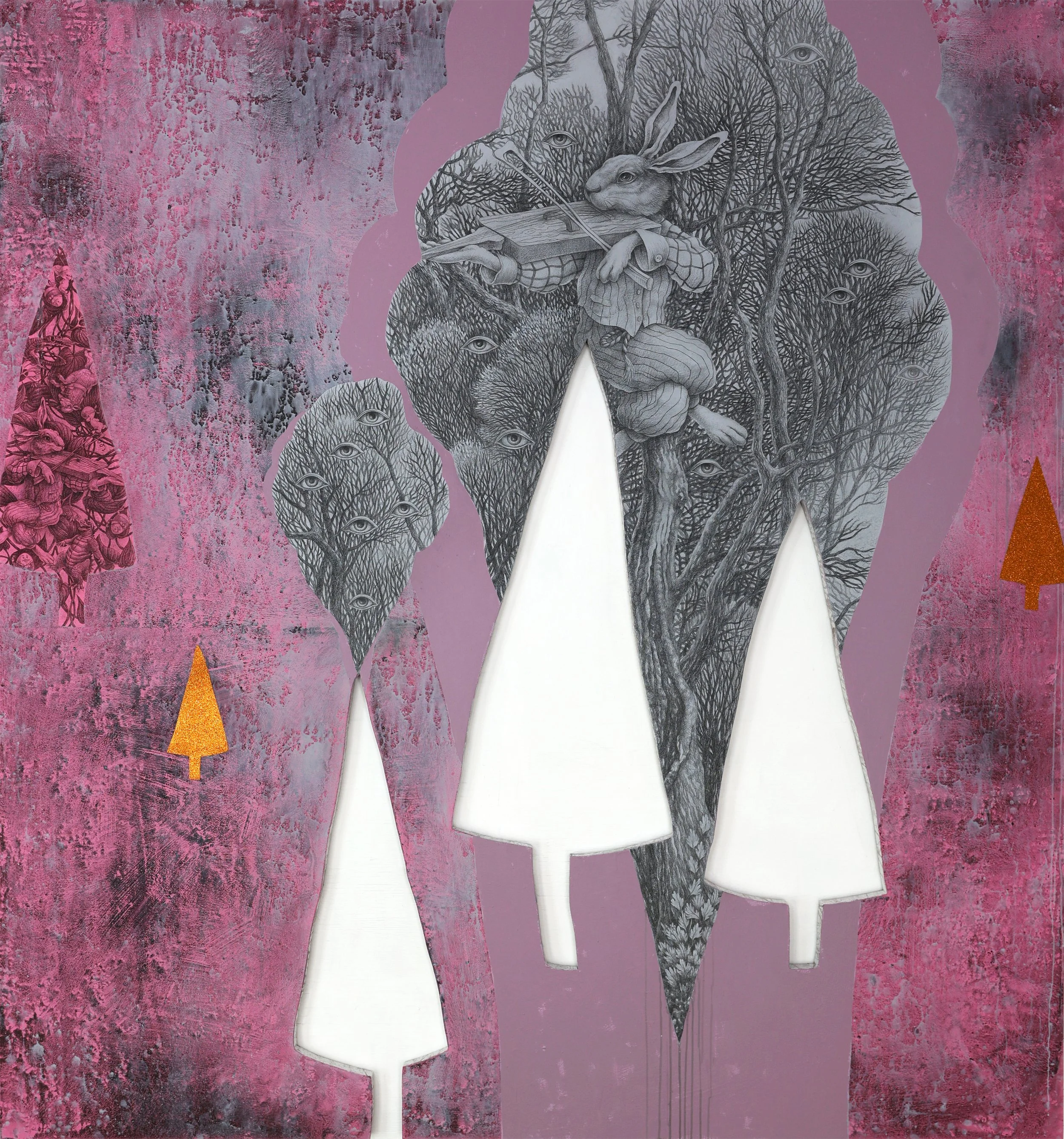
Patricia Bellan-Gillen, Fiddling/The Ghosts of the Last Christmas Trees, Colored pencil, acrylic, glitter on birch, 88” X 84”, 2026
Who is an artist that you think everyone should know about? Why are they significant to you?
Truthfully, I can’t come close to narrowing my list to one artist. It is most meaningful to me to constantly look at a wide variety of artists, working in a variety of mediums and covering a variety of concepts. The artists whose work I seem to go back to most often are William Kentridge, Louise Bourgeois, Jose Bedia, Mel Chin, Firelei Báez, Martin Mull, Mark Bradford and Julian Schnabel. Recently, I’ve been looking at the numerous, lesser-known abstract works of Georgia O’Keefe. I love the feeling that she seemed to have intellectual, emotional and physical imperatives to make paintings. I think everyone should know and follow the work of artists in their own communities or reach out to artists to form a community. I was fortunate to live in Pittsburgh and follow the exquisite work of artists Edward Eberle and Thad Mosely over the years. Everyone should know about them!
Of the children’s stories and fairy tales you reference in your work, is there one that resonates the most for you? Why? How does it apply to our current times?
The White Rabbit, Pinocchio, Jack Pumpkinhead and Humpty Dumpty are characters that appear frequently in my drawings. Like many characters from fairytales and folklore, the passage of time has enshrined them as easily identifiable symbols, but the stories and characters are deeper in meaning than one simple interpretation. They carry moral and political lessons that are relevant to life in the year 2026. The stories, characters and illustrations of each resonate deeply with me, but if I had to choose one I would point to Pinocchio, TheStory of a Puppet (1893). Pinocchio, with his elongated nose gives us the liar. But when reclaimed from the soft brush of Disney, the original, richly layered text of Carlo Collodi’s Pinocchio, which first appeared as serial installments in Italian newspapers, is a dark commentary on the extreme disparity of wealth in mid-19th century Italy and a rally cry for universal education.
I can’t leave out Humpty Dumpty from Through the Looking Glass (1871), whose brusque quote to Alice, “Words mean exactly what I say they mean, no more, no less” echoes the pompous and dismissive tone of many politicians today. His quote, “If you don’t know where you are going, you are sure to get there,” strangely seems to sum up the dismissal of expertise, intellectual rigor and scientific research we are experiencing today.
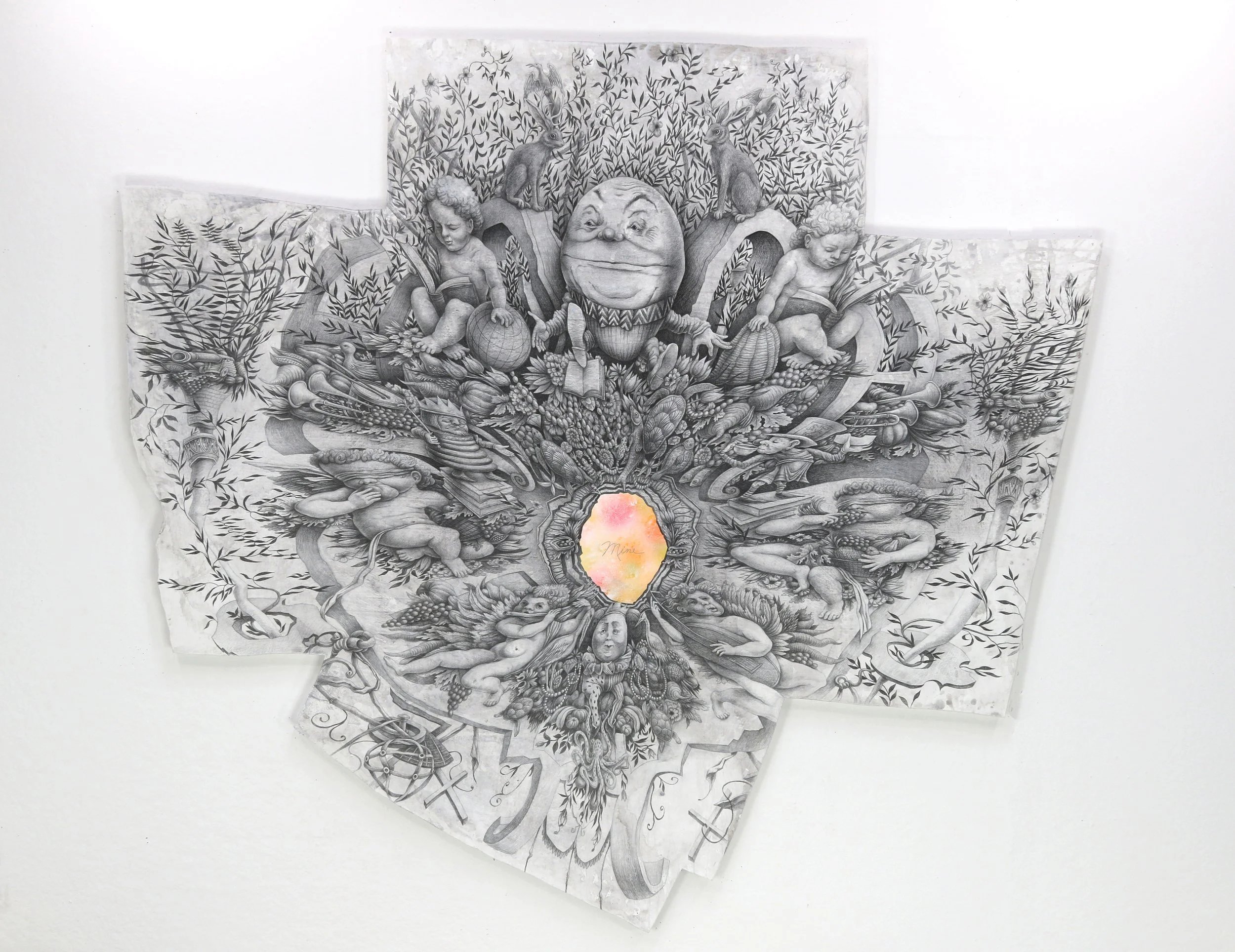
Patricia Bellan-Gillen, Weaponed Words/MINE, Colored pencil, acrylic, collage on birch, 84” X 87”, 2020
You describe your work as “a celebration of the act of drawing.” Why do you gravitate to this art making process?
Drawing simply feels right, feels good to me. I like the immediacy of the pencil point against the ground and the raw, sometimes unfinished quality of drawing that reveals the process as it builds the image.
Can you tell us about the origins/references of the poetic title for the exhibition, Monsters Beloveds and Invisibles Whales?
Alexi Morrisey, an artist and writer from Pittsburgh wrote these beautiful passages about my work.
“If there was just one thing I could teach my children to really know. To instinctually act on in their heart. To accept as a truth beyond measure, or amendment. I want them to welcome the discomfort of holding these two thoughts in their heads, at the same time. That the world is full of monsters, and the world is full of beloveds. There is hate and there is love. There are demonic acts of brutality, and there is generosity of spirit. There are tears, and there is laughter. And one can never truly cancel the other. One can never win over the other. That is the heartbreak of life, and its only clarity. Pat’s work is the best example of this I’ve ever seen. It’s so dire, and so sweet, all at the same time on these simple surfaces. The darkness is pouring out of these surfaces. Right into our eyeballs. It’s a lot. But there are tricksters amongst the ruins. And the trickster never admits defeat. Never."
To Alexi’s Monsters and Beloveds, I added the Invisible Whales to reflect on my love of literature and personal thoughts on the human condition: chasing what may harm us in Moby Dick, waiting for the whale to scoop us up and save us in the bible story of Jonah and theWhale and the test of bravery and selflessness to make us human in Pinocchio.
Patrica Bellen-Gillen’s exhibition Monsters, Beloveds and Invisible Whales is on view at the Erie Art Museum from September 3, 2026 through March 07, 2027.